Ageism

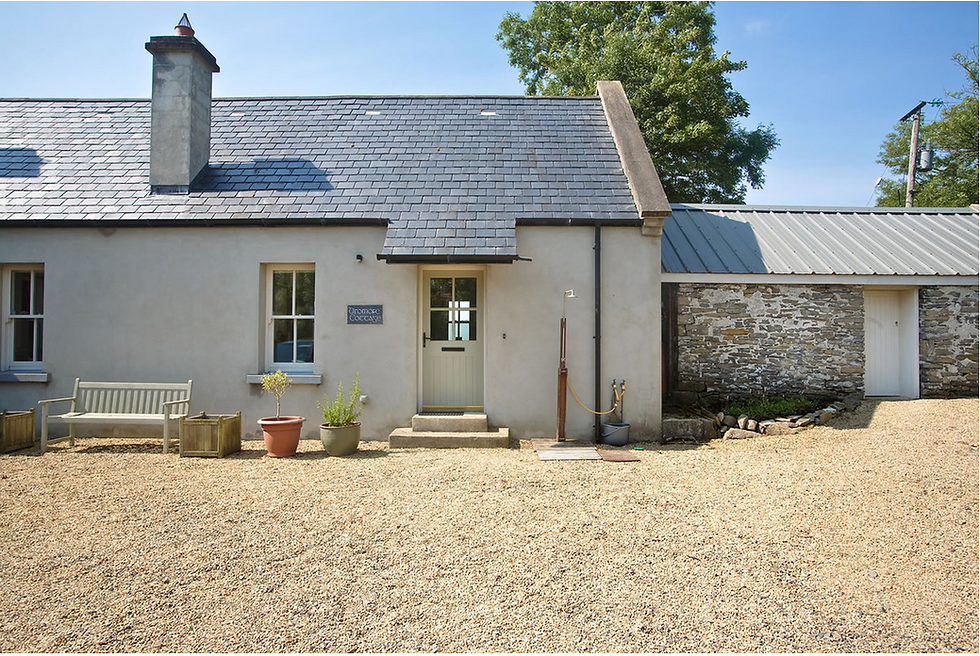
Generally speaking, there are telltale signs as to how old things are. You can tell how old a cast iron gate is by the amount of rust and by how level the gate hangs. The fresh grain of larch gives way to a honeyed gold, then slowly becomes a silver-grey. Stone walls soften under lichen and moss, and plastered walls and lime washes fade in beautifully uneven streaks.
In modern construction culture, these signs of ageing are often seen as decline, as a warning that ‘this has gone bad’ and a replacement is due. Ageing is seen as a fault, as a blemish to be scrubbed out in the name of maintenance. But in rural Ireland, where the elements cannot be hurried or slowed, weathering has always been part of the life of a building. The creaking of the rusty gate, the mossy roof, and the salt bloom on the gable wall are not simply failures – they are the building’s story written in decades-long chapters.
The patina of time reminds us that not only has an item aged, but it has aged here, in this specific place. The timber fencing will silver differently in Gaoth Dobhair to how it will in Barnesmore, and the limewash of a cottage in a sheltered hillscape will fade differently to that of one on an exposed coastline. Aged elements make a building more itself, more rooted in place, and more irreplaceable.
In traditional Irish architecture, ageing was never simply an aesthetic matter – it was an invitation to care. The lime washing of walls was not only for maintenance, but was also a seasonal ritual, and an occasion for neighbours to help each other out and work side-by-side. The re-thatching of a roof bore not only a new skin of reeds but brought skills, stories, and communities together. Repair was not hidden, but instead celebrated. You could see where the patina of the new stones in the wall differed to that of the original stones, but it did not matter. It was a mark of resilience and resourcefulness, not one of shame and failure.
This is the opposite of the modern ideal where “perfect” means “just like new”. In the perpetual chase to maintain this flash of youth, we lose both the slow beauty of change, and the incredible social fabric that comes from tending to things as a community.
Perhaps we could return to the idea that repair itself is an act of design – that the cycle of ageing, repair and renewal could be incorporated into the life and design of a building from the start. A timber public gathering space in the town square whose oiling and sealing becomes a communal effort every few years, or a thatched panel whose re-thatching brings the parish together to give a helping hand. While such notions could be dismissed as romantic dreams of a bygone time, we risk losing touch of our local communities and relationships if we continue to develop singular, individual mindsets and ideas of ownership.
In this vein, buildings could grow old with dignity, and their care and upkeep can become an ongoing conversation between people, place, material and time. We might come to see ageing not as something to resist, but instead something to embrace and look forward to. We might see it as a sign that a building has lived and breathed, and will continue to do so in rhythm with the buildings and land around it.